Over the course of ten years, I got to know several of these people in the Cerco neighborhood, in Porto. Most of them are young or young adults. Some have been to prison, others have jobs, and others are unemployed. Days seem to hurt more there than anywhere else in the city.
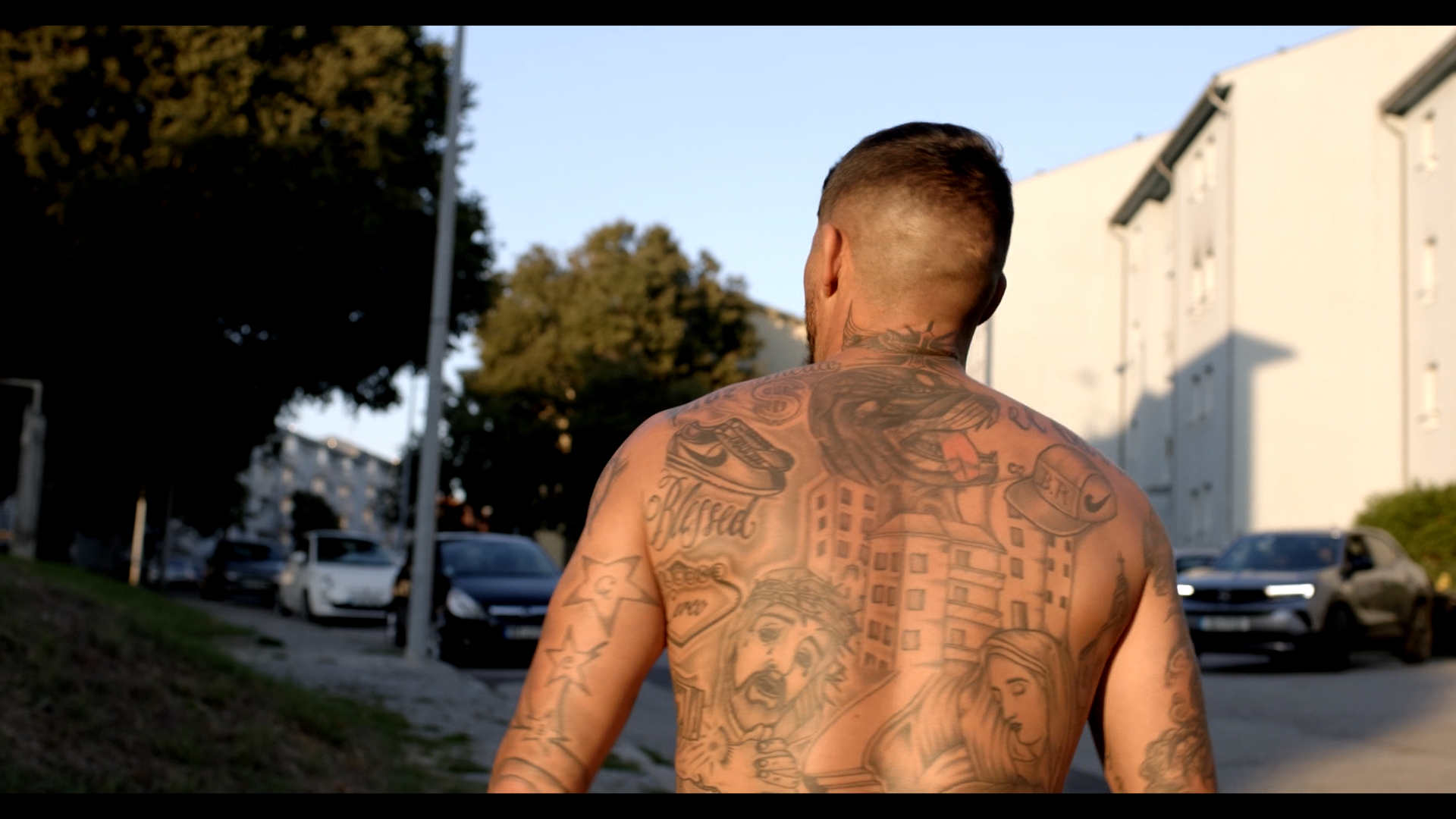
I have seen tough people in moments of deep fragility, in places where violence daily outweighs dialogue, and where the words and drawings painted on skin act as screams. It may seem strange that such personal feelings are displayed on bodies for everyone to see, but perhaps that is the only way to make themselves heard. More than once, I’ve heard someone say, “no one cares about me,” or, in a more collective voice, “no one cares about us.”
“The tattoos from the neighborhoods carry more pain than the others.” That sentence was said to me by Ruizinho many years ago. We met when I was filming a documentary called *Tarrafal*, in 2015. Before it was demolished, Tarrafal was one of the most dangerous neighborhoods in the country — a place where trafficking, violence, and death constantly broke through the surface of daily life. But it was also a place where brotherhood became the anchor that made survival possible. Alone they were nothing. Together they could face anything. Rui opens that film with his eldest daughter in his arms. We became friends and have met several times over the years. I’ve watched his daughters grow up and life unfold, now in the Cerco neighborhood, where he lives.
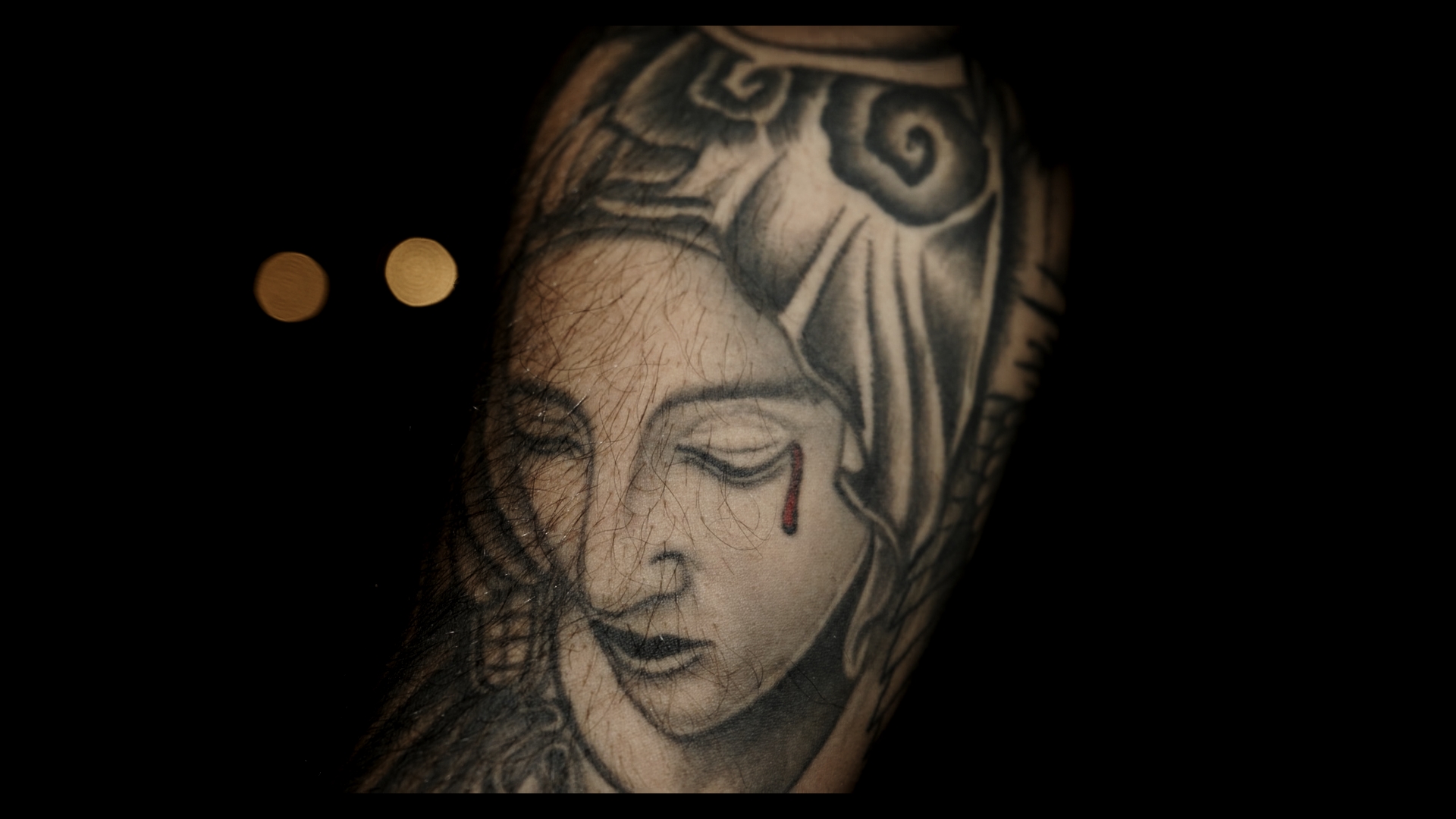
The tattoos represent fragments of many of those lives. There are families who are gone, entire neighborhoods that were demolished, knives, pistols, crying eyes, hands gripping bars, handcuffs, a judge’s gavel, a machine gun, a blade, a joint, a broken heart, a bird flying toward freedom, and the words “God forgives but I don’t” tattooed on skin.
I visited the neighborhood both by day and by night. I spoke with young people, men and women, Roma and non-Roma. From those conversations, I began piecing together fragments — and from them, a series of texts emerged. These will be interpreted by actors and actresses. Through the tattoos and the whispered texts, in an aesthetic reminiscent of *Atlas* by Antoine D’Agata, this becomes a search in the darkness for ghosts that linger or are carved into the skin with ink and needles. It is an inward search for the words carried by the wind that no one listens to — words that vanish in alleyways where, all too often, violence seems to be the only path.